Inspiring STEM Series
About the Inspiring STEM Series
The Inspiring STEM Series creates inspiring, immersive STEM experiences for first-year students. Each year, a Lamar faculty member sparks curiosity with one big idea and real-life examples, and undergraduate researchers show how that same idea is used in the real world. The series is open to attend for first-year STEM majors and non-STEM majors alike, and every presentation is designed to be exploratory, story-driven and full of images and demonstrations.
The faculty talk
A Unified Approach to Demographic Parity and Spatial Segmentation via Constrained Spectral Clustering
Every second, clustering algorithms quietly sort massive datasets to find hidden patterns in our digital world, from social networks to credit risk to spotting a tumor in a medical CT scan. Dr. Ojeda-Ruiz showed how mathematicians speed these algorithms up for networks with millions of points by borrowing a multi-scale strategy from engineering called Algebraic Multi-grid. He then showed how the same math can make algorithms fairer: by writing "fairness rules" as algebraic constraints, an algorithm can be required to keep every demographic group fairly represented instead of repeating historical inequalities.
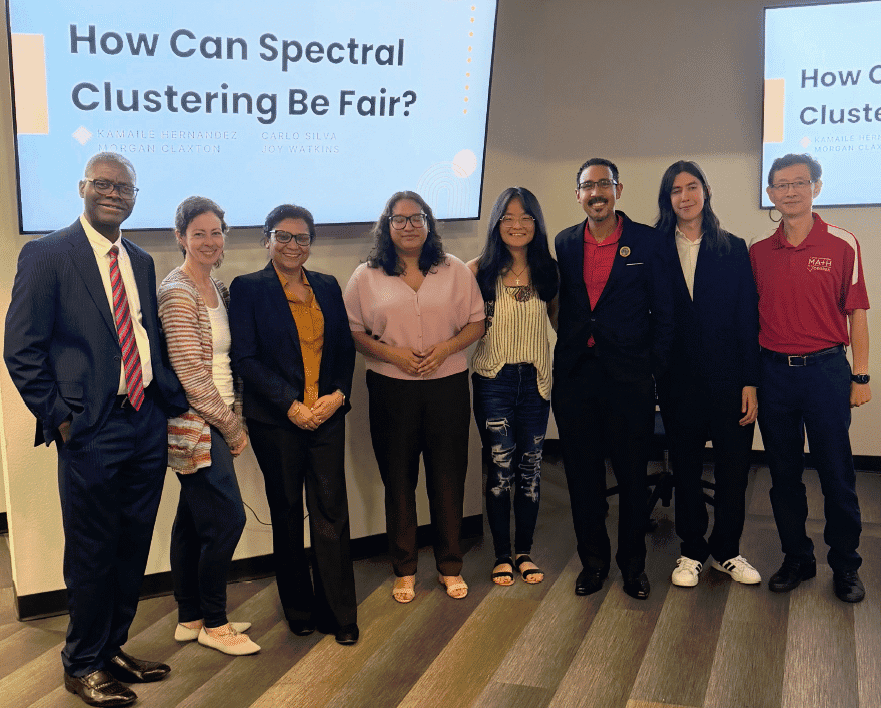
Student research: "How Can Spectral Clustering Be Fair?"
Student researchers Kamaile Hernandez-Linkee and Carlo Silva followed with their own presentation, showing how fairness constraints work in practice and what their research has found. Hearing from fellow students showed first-year students that they, too, can take part in real research at Lamar.
How this supports our goals
The Inspiring STEM Series supports Title III Goal 1: increase STEM student retention, persistence and graduation rates. By connecting first-year students with faculty and undergraduate researchers early, the series builds curiosity, a sense of belonging and lasting interest in STEM.
Event at a glance
Wednesday, September 9, 2026
12:00p.m.–1:00 p.m.
Dr. Richard L. Price Auditorium, Herman Iles Building
Dr. Iván Ojeda-Ruiz, Department of Mathematics
Kamaile Hernandez-Linkee and Carlo Silva
First-year STEM and non-STEM students
Senior Associate Provost’s Office for Academic Affairs and the Title III Office
Next Inspiring STEM Series
Each year, one Lamar faculty member is selected to present, paired with an undergraduate researcher.- Nov-Dec: applications open.
- Jan-Feb: STEM council selects the presenter.
- Mar-May: draft submission and feedback , final revisions.
- Aug-Sep: presentation, weeks 2-3 of fall.