
Robert Rauschenberg
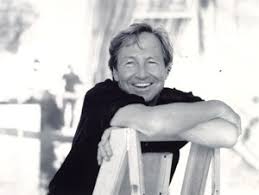
(1925-2008)
Robert Rauschenberg was one of the most influential and internationally recognized artists of the 20th century. He revolutionized the concept of art in the 1950s by uniting sculpture and painting into objects he labeled as Combines. Extremely prolific, experimental, and always on the cutting edge of new, Rauschenberg excelled in painting, sculpture, printmaking, and photography. He collaborated frequently with other visual artists, musicians, choreographers, and writers.
Rauschenberg, at one time labeled the “bad boy” of American modernism, liked to turn art on its end with his experimentations. He was determined not to repeat himself and was known to even destroy silkscreens to prevent repetition. He could make art with any materials available: from a mattress, a tire and a taxidermy goat to door frames and chairs. When he moved to Captiva Island from NY and could no longer gather discarded objects on the streets, he made a conscious decision to make art from a material he could find anywhere he travelled: cardboard. He made large cardboard sculptures, lithographic prints that simulated cardboard and even clay pieces made to look like compressed cardboard boxes.
In 1997, the Guggenheim Museum in NY organized a retrospective comprised of approximately 500 Rauschenberg works. The exhibition, curated by Walter Hopps and Susan Davison of The Menil Collection in Houston, started in NY and then traveled to Houston in 1998 before going on to various venues in Europe. The exhibition was so large that it required three Houston museums to display it all. The Contemporary Art Museum (CAM) held the experimental, performance-based works such as Mud Muse, which was comprised of a large container that bubbled and projected mud into the air. The Menil Collection housed the early combines, paintings and sculptures, such as the glass tires that the contemporary Texas online art magazine is named for. The Museum of Fine Arts exhibited the ¼ Mile or 2 Furlong Piece, a 190-piece paneled work of varying media created over a 17-year period.
Rauschenberg was born in Port Arthur, Texas. He briefly studied pharmacology at the University of Texas before joining the Navy. After serving his time in the military, he began making art at the Kansas City Art Institute and the Academie Julian in Paris before landing at Black Mountain College in NC. Here he studied painting under German Bauhaus founder Josef Albers and met avant-garde musician John Cage.
Rauschenberg had his first solo art exhibition with Betty Parsons Gallery in NY in 1951. He won the prestigious International Grand Prize in Painting in the Venice Biennale in 1963. His art has been exhibited globally ever since. He has received countless awards and been collected by every major museum in the world. A small sampling of his museum representation includes the Art Institute of Chicago, Centre Pompidou in Paris, France, The Museum of Modern Art in NY, Solomon Guggenheim Museum in NY, the Tate Gallery in London, the Tokyo Museum of Contemporary Art, the Whitney Museum of American Art in NY, the Art Museum of Southeast Texas in Beaumont and the Museum of the Gulf Coast in Port Arthur.
Art on Campus
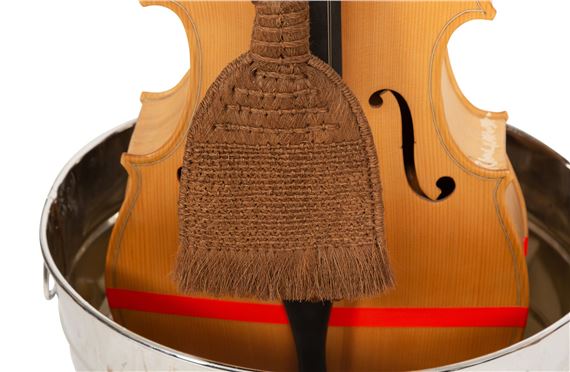
Title: Tibetan Garden Song
Year: 1986
Medium: Mixed Media
Edition: AP, Edition of 25 (only 20 completed)
Location: Music Building First Floor
Gift of Rob Clark and Jerry Thacker
In 1985 Rauschenberg created the Rauschenberg Overseas Culture Interchange (ROCI) “to promote world understanding and peace through art.” He travelled to 10 countries where human rights and artistic experimentation were repressed. In each country, Rauschenberg would learn about the traditions of the area, document his experiences through film, gather materials, and create an exhibition of artwork to commemorate the visit. In all, he produced over 125 paintings, sculptures, photographs, and editioned pieces based on his travels.
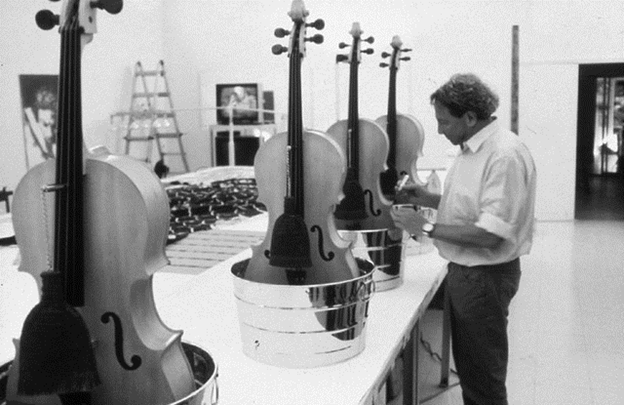
Tibetan Garden Song was created in 1986 after Rauschenberg’s visit to Tibet. He found it difficult to create works to represent Tibet “because they have that total respect for all things… There is no hierarchy in materials… I thought they were so close to my own sensibility that I think that was the most difficult show I had to make.” He used materials from his home state of Florida to make the art representing Tibet. He made one original sculpture called Song for Tibetan Saga that was made of a washtub holding a Chinese cello with a brick suspended from the neck. He then worked with Graphicstudio at the University of South Florida to create an edition of similar works. Ken Elliott, who was tasked with working on the pieces, said he didn’t know why Rauschenberg used the materials he chose other than his fascination with the found objects and their beauty. The editioned pieces, of which only 20 were realized, are comprised of a chrome plated wash tub, a child’s cello, glycerin and mirrored Plexiglas. A Chinese scroll maker’s brush replaced the brick. Scroll maker's brushes (which have been used for thousands of years to apply a paper backing to calligraphed rice paper artwork) are made from animal hair and have a unique shape and texture that likely appealed to Rauschenberg’s interest in ready-made objects.
This particular sculpture is an Artist’s Proof (AP) that was given to a GraphicStudio staff member, Eric Vontillius, who worked on the edition. He was not allowed to sell it while employed. After retiring from the University of South Florida, he sold the work to another owner who held it until purchased by Rob Clark. Other sculptures from this edition may be found in the National Gallery of Art in Washington, DC, the University of Lethbridge Art Collection in Alberta, Canada, the Harn Museum of Art in Gainesville, FL, the Polk Museum of Art in Lakeland, FL and the Robert Rauschenberg Foundation in NY.
Though Lamar University’s music curriculum does not include stringed instruments, the music building is the most logical place to display this important piece of public art. This cello is obviously not meant to be played but was selected because of the beauty of its appearance. The shape alone is recognizable and makes one think of music. The combination of incongruous materials in this artwork commands a viewer’s attention and invites exploration and investigation of its purpose. This sculpture is by an art historically significant artist who has ties to Southeast Texas and who made a mark on the world with his creations not only in the visual arts, but also through his collaborations in all the fine arts disciplines of music, theatre and dance. As a meaningful example relating directly to music history, John Cage’s most famous composition 4’33” was directly inspired by Rauschenberg’s White Paintings of 1951.