
LU expands mathematics degree pathways with accelerated programs
Lamar University's (LU) Department of Mathematics is offering two fast-track degree pathways that allow students to earn both a bachelor's and master's degree in five years, along with an updated mathematics education concentration designed to prepare future teachers.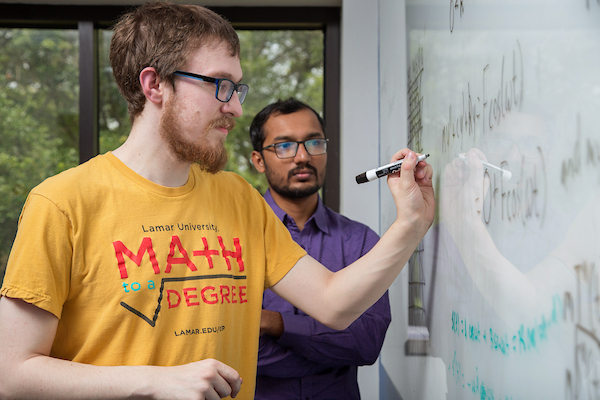
The accelerated programs allow qualified students to complete a Bachelor of Science in Mathematics and a Master of Science in either Mathematics or Computational and Quantitative Methods (CQM), reducing the time typically required to earn both degrees by one year.
"This allows students to leave LU with two degrees in five years, while still ensuring that they are ready for further graduate study or employment in government, financial, or other industry sectors where an understanding of big data is helpful," Dr. Jacqueline Jensen-Vallin, professor and chair of the Department of Mathematics said.
Students enrolled in either fast-track program can earn up to 12 hours of graduate credit while completing their undergraduate coursework. Those credits count toward both degrees, allowing students to begin their master's degree requirements before finishing their bachelor's degree.
Dr. PJ Couch, professor of mathematics, said the structure also offers a financial advantage for students considering graduate education.
"If you're enrolled as an undergraduate student, you can still use your same financial aid and still get graduate credit," Couch said.
Because students remain enrolled in undergraduate courses while completing the additional graduate-level requirements, they may continue using eligible undergraduate financial aid during that portion of their studies.
The two accelerated pathways serve different academic and professional interests.
The traditional mathematics fast-track program emphasizes advanced mathematical theory and research, preparing students for doctoral study, higher education and careers requiring specialized mathematical knowledge. Coursework includes subjects such as real analysis, modern algebra, numerical analysis and statistics.
The CQM pathway focuses more directly on applying mathematics to real-world problems through data analysis, predictive modeling and computational methods.
"The applications of data science are kind of far-reaching," Couch said. "You could work in finance, you could work in business."
Jensen-Vallin said the CQM pathway also incorporates coursework outside mathematics to help students develop skills applicable to various industries.
"Students completing the Fast Track in CQM are also taking courses in business, computer science, or other applied fields," Jensen-Vallin said.
Students also complete applied projects or internships designed to provide practical experience. The curriculum includes advanced machine learning, predictive analytics and time series analysis, preparing graduates to analyze large data sets and identify trends that can inform decision-making.
Couch said the interdisciplinary nature of the program also creates opportunities for students with backgrounds in engineering, computer science and other scientific fields.
"You don't have to have pursued an undergraduate degree in math," Couch said. "You could come from engineering. You could come from one of the sciences, and you would still possibly have all the background materials that you need."
Beyond the accelerated programs, the department has updated its existing Bachelor of Science in Mathematics with a Mathematics Education concentration.
Although the concentration is not new, the revised degree plan maintains its focus on preparing students to teach mathematics in middle and high schools.
"The purpose remains the same: to prepare students for careers in education," Jensen-Vallin said.
The curriculum combines advanced mathematics with education coursework, classroom management, teaching methods and clinical teaching experience. Students completing the concentration are prepared to pursue Texas teacher certification for grades 7-12.
Couch said the fast-track structure also allows undergraduate students to explore graduate-level coursework without immediately committing to completing a master's degree. Students who find the additional coursework too demanding can continue in the undergraduate version of the course.
The programs are included in LU’s 2026-27 academic offerings, with students already enrolled in the accelerated pathways.
For more information about the degree options, visit the Lamar University Department of Mathematics.