
For Jeff Forret, the archive holds stories stranger than fiction
Before discussing slavery, archival research or award-winning books, Dr. Jeff Forret talked about saxophones.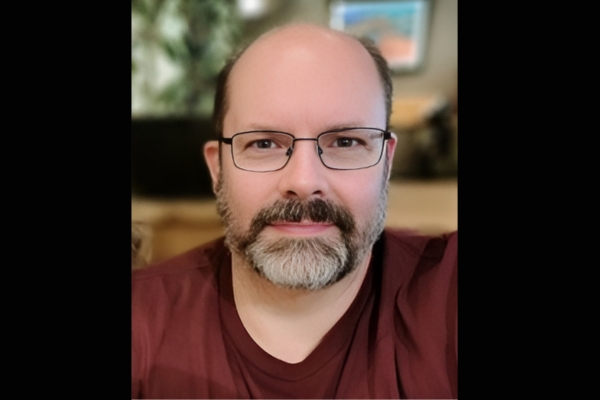
Specifically, a bass saxophone from somewhere around the 1930s.
“That’s my big boy,” he said, showing a photo of a saxophone on his phone.
Forret, a university professor at Lamar University, describes himself first as “a historian of slavery and the American South,” though more recently he has begun working in antebellum Midwestern history as well. But he also identifies as “a husband, father of a teenager, vintage saxophone collector” and “decent saxophonist.”
That mixture of humor, specificity and self-awareness runs through much of how Forret talks about history itself, as something deeply serious, but also deeply human.
Forret said he knew surprisingly early that he wanted to become a history teacher.
“I was in fifth grade when I said I was going to be a history teacher,” he said.
Originally, though, he wanted to be a writer.
“The first job I ever wanted to be in second grade was as a writer,” he said. “I was thinking fiction at the time, but I can’t think of original fiction. It’s all just tropes that we’ve all seen and heard before.”
History, he eventually realized, offered something fiction could not.
“One of the great benefits of being a historian,” he said, “is that you head to the archives and you find stories that are way better than anything I could have imagined anyway.”
Those stories have shaped a career that has earned national recognition. Forret, who was named University Professor in 2023, has written extensively on slavery, violence and race relations in nineteenth-century America. His latest book, “The Price They Paid: Slavery, Shipwrecks, and Reparations Before the Civil War”, won the North American Society for Oceanic History’s John R. Lyman Book Award for best book in North American maritime history published in 2024.
But many of his projects began with accidents — small archival discoveries that grew into something much larger.
While researching gold mining in North Carolina during graduate school, Forret encountered a runaway slave advertisement involving an enslaved man accused of secretly mining gold with a poor white man.
“I’m like, something’s going on there,” he recalled.
That discovery eventually evolved into later research examining relationships between enslaved people and poor white communities in the antebellum South.
Forret said that process remains one of the most rewarding parts of historical research.
“Most of my books have spun out of a previous project,” he said.
Even the mechanics of research have changed dramatically during his career. Early on, archival work meant sitting in libraries for hours manually copying information. Smartphones transformed that process.
“When I first started out, you had to go to the archives and you couldn’t pay to print everything,” he said. “You’d have to go there and sit and type things out.”
Now, researchers can photograph thousands of pages in a matter of days and analyze them later.
While researching in the British National Archives, Forret spent several days photographing uncatalogued materials with the help of archivists carefully unfolding fragile documents.
“I left that three-day stay at the archives with like 1,200 images in my phone,” he said. “I had no idea what was in any of them.”
In the classroom, Forret teaches subjects that are often difficult and emotionally heavy, particularly slavery. Rather than avoiding that discomfort, he sees it as necessary.
“There’s no escaping that,” he said.
Still, he deliberately structures his courses to emphasize the agency of enslaved people rather than portraying them solely as victims.
“It’s far more complicated than just the master says this and the slave does exactly that,” he said.
He also tries to broaden students’ understanding of whose stories count as history.
“I still have sort of the master narrative. George Washington is in the class, Thomas Jefferson is in the class, Abraham Lincoln is in the class,” he said. “But so too are Native Americans, so too are enslaved people, so too are women and poor people.”
Forret said the most important thing he hopes students take from his classes is not memorization, but critical thinking.
“I don’t have to memorize anything. My tests are open note,” he said. “I want them to think clearly.”
That emphasis extends into writing, which he describes as a skill that can never really be mastered.
“I try and teach everything I know about writing in one semester,” he said. “Which is a challenge, because I never finished learning how to write well.”
Outside the university, Forret spends much of his time working in his yard and planting trees around his home.
“I’ve created a little microclimate around my house,” he said.
The shade, he explained, allows him to mow in the middle of the afternoon, even during Southeast Texas summers.
Forret laughed while comparing today’s heat to complaints he has encountered in nineteenth-century plantation journals.
“I have seen so many plantation journals from places like Mississippi in July, and they complained about how hot it was because it was 85,” he said.
For all of his humor and casual storytelling, Forret remains deeply serious about what history can reveal about the present.
“I’m far more interested in the dark stories, the scandals, the conflicts that have marked our past,” he said. “There are all of these echoes that we have today.”