
Lamar University awarded $678,003 grant for youth flood resilience initiative
Lamar University has received a $678,003 grant from the Gulf Research Program of the National Academies of Sciences, Engineering, and Medicine, in partnership with NOAA’s Environmental Literacy Program, to launch a three-year environmental education initiative focused on flooding and community resilience in Southeast Texas.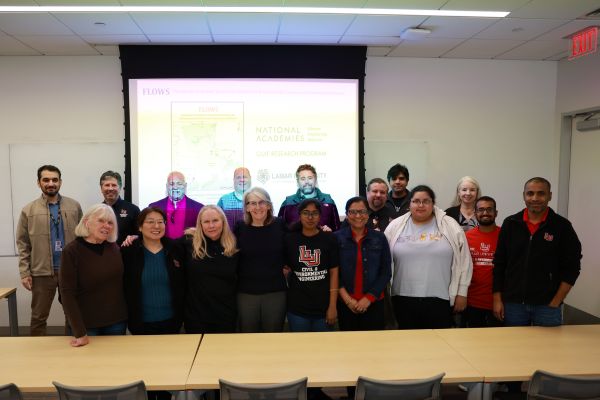
The project, titled FLOWS: FloodSmart Southeast Texas Youth Initiative for Environmental Literacy and Community Resilience, will engage students in grades 8–10 in Beaumont, Port Arthur, and Orange in hands-on learning related to flooding, stormwater management, and nature-based solutions. Students will participate in the design, construction, and monitoring of rain gardens on school campuses.
Led by Dr. Thinesh Selvaratnam, associate professor in Lamar University’s Department of Civil and Environmental Engineering, the project combines TEKS-aligned classroom instruction with field investigations conducted at Lamar University and participating schools. Students will assess sites, help design and install rain gardens, and collect data to evaluate how the systems reduce runoff and improve local flood resilience.
The project will run from October 2025 through September 2028 and is expected to reach more than 300 students and at least 20 teachers, with three demonstration rain gardens installed across the Golden Triangle region. The initiative is based in Lamar University’s Center for Resiliency, which focuses on interdisciplinary research and outreach related to flooding, climate impacts, and community resilience.
The FLOWS leadership team includes co-principal investigators Dr. Mamta Singh, professor of science education; Dr. Liv Haselbach, professor of civil and environmental engineering; Dr. Qin Qian, professor of civil and environmental engineering; and Dr. Berna Eren Tokgoz, associate professor of industrial and systems engineering. The Center for Resiliency will oversee project coordination, communication, data collection, and evaluation.
Community leadership for the project is coordinated by Marilyn Guidry of the Sabine-Neches Chapter of the Texas Master Naturalists, who serves as community liaison. Additional contributors include Mary Bernard, coordinator of the Big Thicket Biosphere Reserve, and school-based leaders Bilal Cindioglu of Harmony Science Academy–Beaumont, Margo Eugenio of Bridge City High School, and Itzanami Madrid of Silsbee High School.
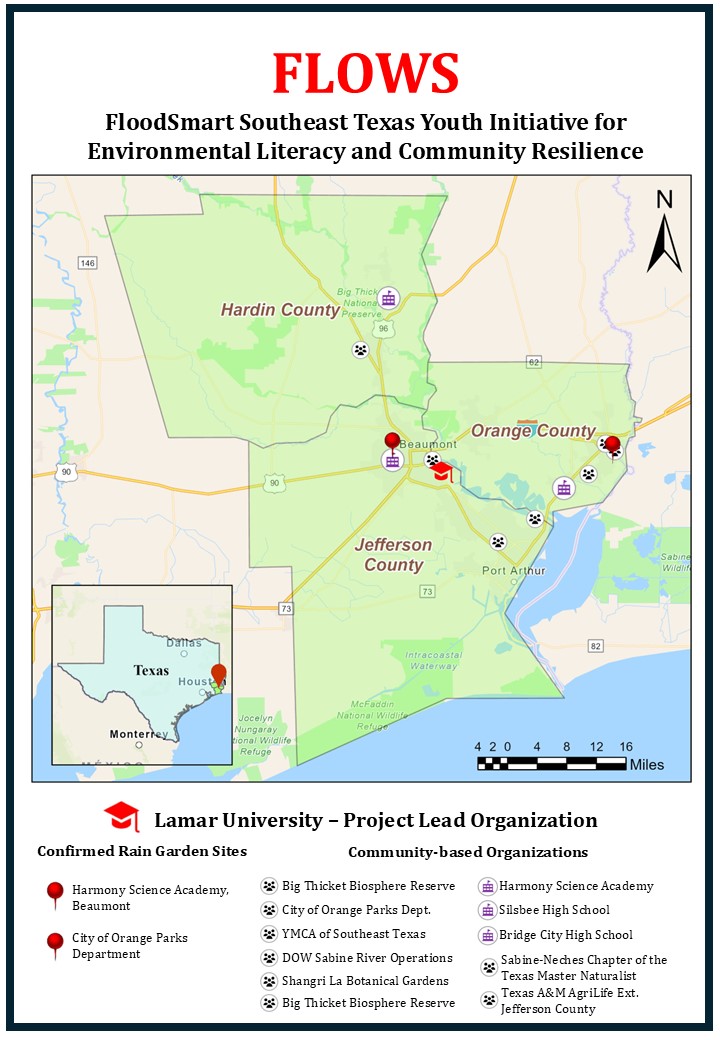
Community partners include the Sabine-Neches Chapter of the Texas Master Naturalists, Big Thicket Biosphere Reserve, Big Thicket National Preserve, Big Thicket Natural Heritage Trust, Texas A&M AgriLife Extension–Jefferson County, YMCA of Southeast Texas, Shangri La Botanical Gardens, the City of Orange Parks Department, and Dow Sabine River Operations.
As part of the initiative, FLOWS will host annual summer training institutes at Lamar University for in-service and pre-service teachers. The program will also develop a modular rain garden teaching kit for schools with limited space, allowing students to conduct smaller-scale investigations of soil, plants, water quality, and flood mitigation.
University officials said the project is designed to strengthen environmental literacy, support community resilience, and serve as a model for other Gulf Coast communities facing similar flooding challenges.