AAQEP Annual Report 2025
Provider/Program Name: Lamar University School Counseling Program
End Date of Current AAQEP Accreditation Term (or “n/a” if not yet accredited): 2029
PART I: Publicly Available Program Performance and Candidate Achievement Data
- Overview and Context
This overview describes the mission and context of the educator preparation provider and the programs included in its AAQEP review.
The College of Education and Human Development at Lamar University generates a community of collaboration through innovative curricula, scholarship, and service learning to inspire our diverse student population and to positively impact their lives and others in Southeast Texas and beyond.
Located near Houston in Beaumont, TX, Lamar University is part of the Texas State University System. Lamar University has been nationally recognized for the quality of its core curriculum and the diversity of its student body.
The mission of Master’s Degree in Education in Counseling and Development with a Professional School Counseling Concentration is to nurture the professional and personal development of students by empowering them with the knowledge, skills, and experiences to become culturally competent and effective professional school counselors. In fulfillment of the program mission, the faculty are dedicated to training leaders in professional school counseling who are capable of thriving in an ever-changing society, with the ability to successfully create and manage a comprehensive school counseling program that addresses the diverse needs of all students in the areas of academic, career, personal, and social development.
The vision of the program is to continuously assess and align standards with professional organizations for the foundational elements of culturally relevant and comprehensive school counseling.
The School Counseling program is a 60-hour program geared for both certification in school counseling and licensure as an LPCC. It is delivered in a fully online format designed to provide flexibility and accessibility for working professionals across Texas and beyond. Courses are offered in an accelerated five-week rotation, allowing students to engage deeply with content while maintaining momentum toward degree completion. Although the program is primarily online, students participate in one required on-campus residency week, which provides essential opportunities for hands-on skill development, professional networking, and faculty engagement.
© Association for Advancing Quality in Educator Preparation – 2025
Public Posting URL
Part I of this report is posted at the following web address (accredited members filing this report must post at least Part I): https://www.lamar.edu/education/educator - preparation/aaqep.html - Enrollment and Completion Data
Table 1 shows current enrollment and recent completion data, disaggregated by program and license/certificate, for each program included in the AAQEP review.
Table 1. Program Specification: Enrollment and Completers for Academic Year 2024-2025
Degree or Program offered by the institution/organization
Certificate, License, Endorsement, or Other Credential granted by the state
Number of
Candidates Enrolled in most recently completed academic
year (12 months ending 05/2025)Number of
Completers
in most recently completed academic year (12 months ending 05/2025)Programs that lead to initial teaching credentials
Total for programs that lead to initial credentials
N/A
Programs that lead to additional or advanced credentials for already-licensed educators
Total for programs that lead to additional/advanced credentials
1217
292
Programs that lead to P-12 leader credentials
Total for programs that lead to P-12 leader credentials
N/A
Programs that lead to credentials for specialized professionals or to no specific credential
Total for programs that lead to specialized professional or no specific credentials
TOTAL enrollment and productivity for all programs
1217
292
Unduplicated total of all program candidates and completers
1217
292
Added or Discontinued Programs Any programs within the AAQEP review that have been added or discontinued within the past year are listed below. (This list is required only from providers with accredited programs.)
N/A
- Program Performance Indicators
The program performance information in Table 2 applies to the academic year indicated in Table 1.
Table 2. Program Performance Indicators
A. Total enrollment in the educator preparation programs shown in Table 1. This figure is an unduplicated count, i.e., individuals earning more than one credential may be counted in more than one line above but only once here.N = 1217
B. Total number of unique completers (across all programs) included in Table 1. This figure is an unduplicated count, i.e., individuals who earned more than one credential may be counted in more than one line above but only once here.N = 292
C. Number of recommendations for certificate, license, or endorsement included in Table 1.N = 243
D. Cohort completion rates for candidates who completed the various programs within their respective program’s expected timeframe and in 1.5 times the expected timeframe.Ontime completion rates 232 out of 292 (79.5%) and 1.5x completion rates 14 out of 292 (4.8%)
E. Summary of state license examination results , including teacher performance assessments, and specification of any examinations on which the pass rate (cumulative at time of reporting) was below 80%.Pass rate on the TExES 252 for AY 2024-25 is 97%
F. Explanation of evidence available from program completers, with a characterization of findings.The School Counseling Exit Survey is presented to candidates at the completion of their program. In AY 2023/24, results were as follows.
Item
% Agree or
Strongly
Agree
2024% Agree or
Strongly
Agree
2025N = 121
N = 153
I am prepared to implement K-12 career/college readiness pathways as a major part of my work
90
94
I am aware of more than one model and/or indicator of cultural competence in the P-20 setting
92
98
I have a strong foundation to understand current issues and trends within my field
96
97.4
My written communication skills have improved
94
97
My public speaking skills have improved
84
92
I am better able to analyze issues, make decisions and overcome problems
96
94.1
I demonstrate originality and inventiveness to a higher level
95
95.4
I am better able to utilize technology as part of my job/career
92
94.1
I am able to articulate the ethics of my field
98
94.8
I would recommend this program to others
95
92.8
Overall Analysis of the School Counseling Program Exit Survey 2024-2025
N = 153
Across all items, responses are overwhelmingly positive. In nearly every row and column, Strongly Agree dominates, with Agree the next most frequent. Neutral or negative selections (Neither/Somewhat disagree/Disagree) appear only sporadically and never in clusters large enough to suggest systemic weakness. A safe, conservative roll-up is that ≥90% of respondents agreed or strongly agreed with each statement, with many items visibly closer to 95%+ positive.
Preparation & practice indicators- Career/college readiness pathways (K–12): Very strong; the vast majority marked Strongly Agree. Alumni perceive they can implement postsecondary/career programming as a major part of their role.
- ASCA Mindsets & Behaviors implementation: Consistently Strongly Agree; indicates strong alignment to the Texas Model/ASCA frameworks.
- Data use / decision-making: Items on analyzing issues, making decisions, using data, and ethical decision-making models show heavy Strongly Agree—graduates feel confident in data-informed, ethical practice.
- Culturally responsive practice & diversity integration: Multiple items (cultural competence models, integrating diversity, engaging communities, practicing responsively in varied contexts) show near-uniform Strongly Agree; only occasional “Somewhat agree.” This aligns tightly with your program mission.
- Understanding learners / productive learning environments: Again, predominantly Strongly Agree; graduates feel able to create and support effective environments across contexts.
-
- Written communication: Mostly Strongly Agree with some Agree—an area of clear strength.
- Public speaking: Still positive overall, but this is one of the few places where Agree appears more often and a handful of Somewhat disagree/neutral responses show up. Interpretation: Alumni feel capable, but confidence is marginally lower here than in other domains.
- Technology use: Heavy Strongly Agree; strong perceived readiness to leverage tech at work.
-
- Goal setting, reflection, and collaboration: Dominated by Strongly Agree—alumni report sustained habits of professional learning and collegial collaboration. Notable outliers (isolated)
- A few single-cell Disagree/Somewhat disagree entries appear (e.g., public speaking, a scattered row including several “Somewhat disagree/Disagree”). These are isolated and not pattern-forming.
-
- Strengths: ASCA/Texas Model alignment, cultural responsiveness, ethics and data-informed practice, technology use, community/family engagement, and overall counseling readiness.
- Watch item: Public speaking shows the highest (still small) concentration of neutral/negative responses relative to other items.
Quick, low-lift improvements
- Public speaking tune-up: Add a short micro-module (recorded mini-lectures + a brief live skills lab) on stakeholder presentations (faculty, board, parent nights), plus optional practice with targeted feedback.
- Continue doing what works: Maintain residency, applied assignments, data/ethics integration, and community-engagement activities since these map to the strongest signals in the data.
G. Explanation of evidence available from employers of program completers , with a characterization of findings. In AY 2024-25, the alumni survey was sent to program completers with 239 responses with the request to provide employer information. Employer responses were limited with only 10 employers responding. Of the 10 employers,9 communicated either adequately or exceptionally prepared graduates and one communicated somewhat preparedness and comments for improvement as an employer of our graduate. This data is presented below.
How well did our
School Counseling Program prepare this graduate for their role?Would you hire another graduate from the Lamar University
Counseling Program?Additional comments or suggestions for program improvement.
Exceptionally prepared
Yes
We work together everyday. She’s great!
Somewhat prepared
No
The student was not well prepared for what to expect with internship with respect to time commitment and did not have any foundational theory or ethics courses prior to starting. She repeatedly told me she did not have any practice with counseling role play or skill building in classes, no understanding of theory and had not even been advised she needed to find a site prior to practicum. When I had problems with this student I had no information on who her professor was as no one had ever introduced themselves. I found an old professor who gave me current information and after emailing that professor my concerns I never heard back from them again. This is very concerning to me as someone who has worked with several students across various universities and concerns me that there is little quality control and certainly no concerns about gate keeping a profession that serves vulnerable populations.
Exceptionally prepared
Yes
She is definitely a valuable asset to our campus.
Exceptionally prepared
Yes
My associate is in a clinical mental health capacity so many of these questions do not apply. She is well prepared as a clinician.
Exceptionally prepared
Yes
Adequately prepared
Yes
Exceptionally prepared
Yes
I find I am always teaching LPC Associates how to document clinical sessions in private practice due to lack of practice in graduate school. I would like to see them have more experience writing clinical notes (DAP, SOAP, etc).
Adequately prepared
Yes
Empathy and unconditional positive regard are strengths of the candidates graduating from your program. They are non judgmental and inclusive. One area of improvement would
be to have a more solid understanding of the fast pace requirement in a school counseling role. Candidates do settle in but that is with a supportive structure provided. It does catch them off guard at the beginning of the year what a fast pace they have to keep up with. Thank you!
Exceptionally prepared
Yes
Exceptionally prepared
Yes
This person is an amazing counselor and an all around great human. Thanks for providing the program to help people like her prepare to take exceptional care of our students.
H. Explanation of how the program investigates employment rates for program completers , with a characterization of findings. This section may also indicate rates of completers’ ongoing education, e.g., graduate study.
The alumni survey of AY 2024/25 (n = 240) revealed that 87% of respondents report securing employment in their degree/certification area. Just over 70% of all respondents both secured employment and did so within 6 months. Other significant findings included: Graduates in school leadership positions: 68% Graduates attending professional conferences: 56% Graduates completing school counseling certification: 78% Graduates who are both licensed and certified: 25% In response to the question, “How would you rate your overall experience at Lamar University in preparing you for the workplace?” , a total of 237 graduates provided feedback using a 5-point scale, where 5 = “Extremely Well” and 1 = “Poor.” Results indicate a high level of confidence in the program’s effectiveness. Nearly half of all respondents (49.4%) selected the highest rating of 5, and an additional 33.3% rated their preparation as a 4. In total, more than 82% of graduates reported being well or extremely well prepared for professional practice. Mid-range responses (3) accounted for 13.5% , while only 3.8% of all ratings (scores of 1 or 2) reflected concerns about workplace readiness.
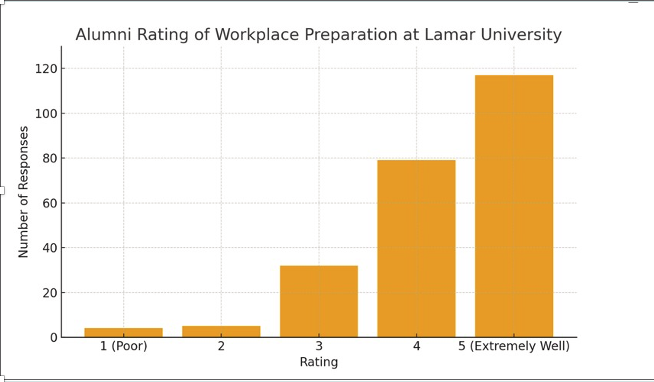
These findings demonstrate that graduates overwhelmingly perceive the program as providing strong and relevant preparation for employment in counseling and related professional roles. The exceptionally low percentage of negative ratings further reinforces the program's effectiveness in equipping students with the knowledge, skills, and competencies required in the field.
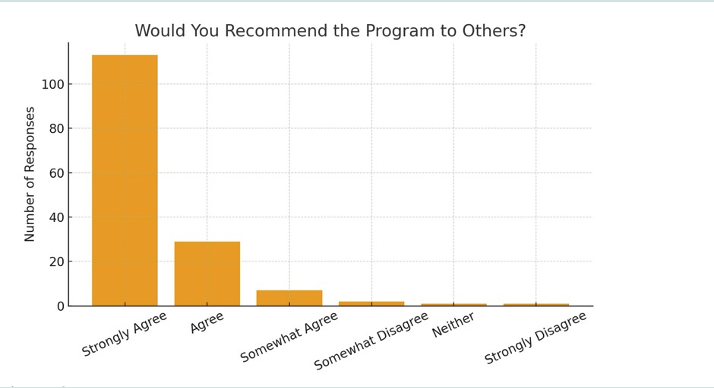
When asked whether they would recommend the program to others, respondents overwhelmingly expressed positive endorsement. Out of 153 total responses, 73.9% selected "Strongly Agree," and an additional 19.0% selected "Agree, " meaning that over 92% of graduates responded favorably. Only 2.0% indicated disagreement (Somewhat Disagree or Strongly Disagree), and less than 1% selected "Neither Agree or Disagree."
These results indicate exceptionally high levels of satisfaction and program loyalty among graduates, suggesting that alumni not only value their experience but are willing to advocate for the program to future students.
I. Explanation of how the staffing capacity for program delivery and administration and quality assurance system monitoring have changed during the reporting year, if at all, and how capacity matches the current size of the program.
Staffing for program delivery has remained the same, with 7 full time faculty instruction, and depending on the term, 4 adjunct professors. With respect to teaching duties, faculty are assigned a full-time Instructional associate (IA) who completes the grading and works with faculty communicating with students. The typical faculty/student ratio is 1:60, inclusive of the IA. Inter-rater reliability (IRR) is used between the faculty member and the IA at least one time per year for continually employed adjuncts and new IAs complete IRR with the faculty member on assignments throughout the first semester.
4. Candidate Academic Performance Indicators
Tables 3 and 4 report on select measures (3 to 5 measures for each standard) of candidate/completer performance related to AAQEP Standards 1 and 2, including the program’s expectations for performance (criteria for success) and indicators of the degree to which those expectations are met.
Table 3. Expectations and Performance on Standard 1:Candidate and Completer Performance
Provider-selected measures (name and description)
Criteria for success
Level or extent of success in meeting the expectation
1a. Content, pedagogical and professional knowledge relevant to the credential or degree being sought.
Candidates completing the program will be successful on the state certification exam at a 90% pass rate.
This benchmark was met at a 97% pass rate for AY 24-25 on the School
Counseling State Certification Exam.1b. Learners, learning theory, including social emotional, and academic dimensions and application of learning theory.
The major assignment in CNDV 5311: Counseling Theories and Techniques directly evaluates students’ ability to understand learners (clients or students in counseling) by assessing their capacity to conceptualize human behavior, apply theoretical frameworks, and integrate cultural, ethical, and developmental considerations into case analysis. This assignment requires candidates to articulate a personal philosophy of human nature, analyze client concerns, and apply counseling theories to understand client motivations, struggles, presenting concerns, and pathways for change.
Because the assignment assesses how students analyze clients’ presenting concerns, conceptualize treatment needs, and select culturally and developmentally appropriate strategies, it is a strong measure of the learning outcome related to understanding learners.
Criteria for success is 90% of students will score at 90%.A total of 227 scored evaluations were collected for this assessment cycle. Students performed at a very high level, with 219 passing the assessment for a 99.03% pass rate. Out of 924 possible points, candidates earned 920 actual points, indicating near-complete mastery across the rubric dimensions. The mean score was 11.77 out of 12, with a median of 12, demonstrating exceptionally strong proficiency in understanding clients through theory application and case conceptualization. Score variability was low (SD = 0.7), and the internal
consistency estimate (KR-20/Cronbach’s Alpha = 0.83) indicates solid reliability across assessment components.1c. Culturally responsive practice, including intersectionality of race, ethnicity, class, gender identify and expression, sexual identity, and the impact of language acquisition and literacy development on learning.
The advocacy assessment serves a dual purpose in evaluating both culturally responsive practice and professional dispositions within the school counseling program. This assessment requires candidates to critically examine the social, cultural, and institutional barriers that impact PK–12 students’ access, opportunity, and success. Through this work, students demonstrate the ability to apply relevant research findings, cultural knowledge, and equity-minded frameworks to inform their advocacy efforts.
In completing the assessment, candidates are expected to integrate cultural self-awareness, understanding of systemic inequities, and knowledge of diverse student populations. They must identify how culture, language, socioeconomic context, and community factors shape students’ educational experiences and then design advocacy actions that are responsive to those unique needs. This demonstrates their growing competence in culturally responsive school counseling practices.A total of 469 scored evaluations were collected for this assessment cycle. Across the five measured domains, candidates demonstrated strong overall performance. Out of the 2345 possible item points, students earned 2161 points, resulting in a 90.19% pass rate (423 of 469 students). The overall mean score was 4.47, with scores ranging from 0.25 to 5, and a median score of 5, indicating that the majority of candidates performed at or near mastery. The standard deviation of 1.39 reflects some variation in performance across the cohort.
1d. Assessment of and for student learning, assessment of data literacy, and the use of data to inform practice.
The Comprehensive School Counseling
Program Design assignment in CNDV 5330: Developmental Guidance requires candidates to integrate technology, accountability methods, and research-based decision-making into each stage of constructing a comprehensive school counseling program informed by the Texas Model.
Throughout the assignment, students must gather, analyze, and apply multiple types of data—including survey results, needs assessments, perception and process data, local and state indicators, and research evidence—to inform program decisions. Proficiency for this goal is demonstrated by 90% of candidates scoring 90% or higher on this measure.A total of 346 scored evaluations were collected for this assessment cycle. Students demonstrated strong overall performance, with 314 passing the assessment for a 90.75% pass rate. Out of 1730 possible points, candidates earned 1602 actual points, indicating high levels of mastery across most assignment components. The mean score was 4.39, with a median score of 4.8, showing that most students performed well above minimum competency expectations.
1e. Creation and development of positive working environments.
The Comprehensive School Counseling
Program Design assignment in CNDV
5330 directly supports candidates’ ability to create and sustain positive working environments. Through the program design process, candidates must analyze school culture, incorporate stakeholder roles, integrate needs assessment data, and develop comprehensive program goals that promote student well-being, staff collaboration, and equitable access to services.
Proficiency is demonstrated by 90% of candidates scoring at the passing rate on the assessment.Assessment results from the CNDV 5330 Developmental Guidance assignment demonstrate that candidates consistently met or exceeded expectations related to AAQEP Standard 1e. Students showed strong competency in designing comprehensive school counseling programs that foster collaborative, equitable, and supportive working environments within P–12 settings.
Across the most recent evaluation cycle, students achieved a 90.75% pass rate , with domain averages ranging from 0 .98 to 0.998 in criteria directly related to building positive working environments, including integrating stakeholder roles, applying needs-assessment data, creating program goals that promote schoolwide well-being, and designing structures for collaboration and communication.1f. Dispositions and behaviors required for successful professional practice.
The School Counseling program set a program goal that candidates will develop and demonstrate intrapersonal awareness and an accurate
understanding of the basic motivations of self. This includes the relationship between personal beliefs, thoughts, feelings, actions, and professional functioning as measured by the
Candidate Professional Characteristics and Disposition Form completed during Residency.
This form also provides direct evidence of key professional dispositions , including commitment to equity, ethical responsibility, respect for diversity, and social justice–oriented thinking.
Proficiency is demonstrated by 90% of candidates by scoring “Meets
Expectations” or a score of 4 of 5 on the Likert scale.A total of 469 scored evaluations were collected for this assessment cycle. Across the five measured domains, candidates demonstrated strong overall performance. Out of the 2345 possible item points, students earned 2161 points, resulting in a 90.19% pass rate (423 of 469 students). The overall mean score was 4.47 , with scores ranging from 0.25 to 5, and a median score of 5, indicating that the majority of candidates performed at or near mastery.
Table 4. Expectations and Performance on Standard 2: Completer Professional Competence and Growth
Provider-selected measures (name and description)
Criteria for success
Level or extent of success in meeting the expectation
2a. Understand and engage local and cultural communities and communicate and foster relationships with
families/guardians/caregivers in a variety of communities90% of candidates will score in the agree/strongly agree range of the School Counseling Exit Survey item: I understand and engage local school and cultural communities and communicate and foster relationships with
families/guardians/caregivers in a variety of communities.Graduate exit survey results indicate that program completers feel highly prepared to engage with diverse school and cultural communities and to foster effective relationships with families and caregivers. Among 153 respondents:
- 65.4% Strongly Agreed
- 32.7% Agreed
- 2.0% Somewhat Agreed
Thus, 98% of graduates indicated agree or strongly agree that they feel prepared
or very prepared to communicate effectively with families, engage local cultural communities, and build strong school–home partnerships.
2b. Engage in culturally responsive educational practices with diverse learners and do so in diverse cultural and socioeconomic contexts
Measure 1 90% of candidates will score in the agree/strongly agree range of the School Counseling Exit Survey item: I engage in culturally responsive educational practices with diverse learners and do so in diverse cultural and socioeconomic contexts.
Measure 2: The advocacy project assessment serves a dual purpose in evaluating both culturally responsive practice and professional dispositions within the school counseling program. This assessment requires candidates to critically examine the social, cultural, and institutional barriers that impact PK–12 students’ access, opportunity, and success. Through this work, students demonstrate the ability to apply relevant research findings, cultural knowledge, and equity-minded frameworks to inform their advocacy efforts.Measure 1: Graduate exit survey data demonstrate that program completers feel highly prepared to engage in culturally responsive educational practices across diverse cultural and socioeconomic contexts. Among 153 respondents, 98.7% selected Agree or Strongly Agree (65.4% Strongly Agree , 33.3% Agree ), while only 1.3% selected “Somewhat Agree” and none disagreed.
Measure 2: A total of 469 scored evaluations were collected for this assessment cycle. Across the five measured domains, candidates demonstrated strong overall performance. Out of the 2345 possible item points, students earned 2161 points, resulting in a 90.19% pass rate (423 of 469 students). The overall mean score was 4.47, with scores ranging from 0.25 to 5, and a median score of 5, indicating that the majority of candidates performed at or near mastery. Specifically, scores addressing this standard were as follows:
Social Justice and Personal Mission:
Average = 0.988, SD = 0.042
Students excelled in articulating culturally responsive perspectives, demonstratingcultural self-awareness, and engaging in justice-oriented advocacy behaviors.
2c. Create productive learning environments and use strategies to develop productive learning environments in a variety of school contexts
The ASCA Student Standards can be applied to three broad domains:
academic, career and social/emotional development. These domains promote mindsets and behaviors that enhance the learning process and create a culture of college-, career- and life-readiness for every student. As part of the School Counseling Exit Survey, candidates score their competency level with respect to implementing the mindsets with their students. In addition, they score their ability to identify ways and follow through to integrate diversity into tasks and initiatives in the majority of areas of work. For both of these items, the program benchmark is set that 90% of candidates agree or strongly agree that they are prepared to succeed in these goals.Graduate exit survey results show that
95.4% of program completers (69.9% Strongly Agree , 27.5% Agree ) report that they effectively implement the ASCA Mindsets with students, a critical indicator of their ability to create and sustain productive learning environments across diverse school contexts. Only 2.6% indicated “Somewhat Agree,” and no respondents disagreed, demonstrating strong overall readiness to apply mindset based strategies that support academic, social/emotional, and career development.2d Support students’ growth in international and global perspectives.
Measure 1: In the Counseling Exit Survey, the survey item: I support students’ growth in international and global perspectives directly addressing 2d.
Measure 2: In addition, the program established this item as part of the School Counseling Exit Survey: I engage in culturally responsive educational practices with diverse learners and do so in diverse cultural and socioeconomic contexts. The benchmark for indicatingMeasure 1: Graduate exit survey results demonstrate that program completers feel well-prepared to support students’ international and global perspectives. Among 153 respondents, 92.2% indicated Agree or Strongly Agree that they help students grow in global and international awareness (54.2% Strongly Agree , 37.9% Agree ). Only 0.7% reported
disagreement, and 7.2% indicated partial or neutral agreement.success for this aspect is that 90% of students will score in the agree and strongly agree categories.
Measure 2: Graduate exit survey results demonstrate that program completers feel highly prepared to engage in culturally responsive educational practices that support students’ global, multicultural, and international perspectives. Among 153 respondents, 98.7% reported that they Agree or Strongly Agree that they effectively implement culturally responsive practices across diverse cultural and socioeconomic contexts (65.4% Strongly Agree , 33.3% Agree ). Only 1.3% reported “Somewhat Agree,” and no respondents disagreed.
2f. Collaborate with colleagues to support professional learning.
Candidates who have spent a minimum of two semesters in the field as a school counselors intern completed the Exit Survey item: On a regular basis, I collaborate with colleagues to support my own professional learning. The benchmark for indicating success for this aspect is that 90% of students will score in the agree and strongly agree categories.
Graduate exit survey results demonstrate that 100% of program completers report regularly collaborating with colleagues to support their professional learning (74.5% Strongly Agree , 25.5% Agree ). No respondents indicated “Somewhat Agree” or “Disagree.”
5. Notes on Progress, Accomplishment, and Innovation
This section describes program accomplishments, efforts, and innovations (strengths and outcomes) to address challenges and priorities over the past year.Over the past year, the School Counseling program has demonstrated strong performance across academic, professional, and field-based indicators. Signature assessments continue to show high levels of mastery, confirming students’ strengths in program development, learner understanding, data-driven decision making, and applied counseling practice.
Certification outcomes remain exceptionally strong (98% and 97% over the past 2 years). Also, over the last two academic years, 80% of all program graduates successfully earned Texas School Counselor certification. TEA reported data indicate a 98% TExES pass rate, with most candidates passing on their first attempt. These results demonstrate the program’s effectiveness in preparing candidates for licensure and professional entry.
In 2025, the response rate on the Alumni Survey was N = 150, with a notable increase in participation from 2024 (N = 26). More than 90% of alumni report feeling well-prepared for professional practice, confident in their counseling skills, and likely to recommend the program to others. Many graduates also reported securing school counseling or related positions within six months of graduation.
Program improvements this year focused on strengthening data-informed practice in the developmental guidance course, infusing multicultural and global perspectives across the curriculum. In addition, faculty are designing a new course for the program specific to measurement and assessment in the school setting to launch in 2026.