
Fast Track Bachelor's Degree/Master's Degree in Mathematics
Degree: Bachelor of Science, Master of Science
Major: Mathematics
Hours: 120 (undergraduate), 30 (graduate)
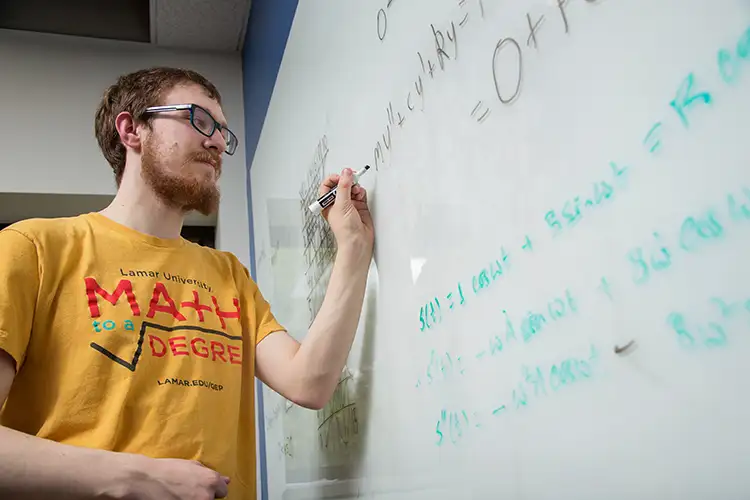
Mathematics Fast Track Overview
The Bachelor of Science/Master of Science in Mathematics Fast Track is designed to allow motivated undergraduate students to earn both B.S. and M.S. degrees in five years. This is achieved by allowing you in the program to take dual-credit courses during your senior year. Students who successfully complete these dual-credit courses will receive both the graduate credit and undergraduate credit.
This program offers a quick way for you to achieve a M.S., and also well-funded positions for graduate teaching assistants and a comprehensive program with a wide range of courses and individual faculty attention. You will be taught by accomplished researchers, and our department places the welfare and teaching of students at the heart of our efforts.
Our graduate faculty members have interests in complex analysis, computability theory, graph theory, integration theory, lie algebras, logic, modeling, numerical analysis, numerical differential equations, probability, statistics and symmetric spaces in addition to the foundational fields of algebra, analysis and topology. In addition, we have faculty members who have joint appointments between our department and the Department of Curriculum and Instruction.
Mathematics Courses You May Take
Linear Algebra: This course introduces and provides models for application of the concepts of vector algebra. Topics include finite dimensional vector spaces and their geometric significance; representing and solving systems of linear equations using multiple methods, including Gaussian elimination and matrix inversion; matrices; determinants; linear transformations; quadradic forms, eigenvalues and eigenvectors; and applications in science and engineering.
Introduction to Advanced Mathematics: This course provides introduction to logic and the basic methods of proof required to be successful in a proof oriented mathematics course. Students will study applications in basic set operations, relations, functions, cardinality, and the real number system to learn the basics of mathematics proofs.
Introduction to the Theory of Statistical Inference: An introduction to calculus-based statistics and probability. Students will study special probability distributions, nature of statistical methods, sampling theory, estimation and testing hypotheses.
Real Variables: This course covers fundamental abstract concepts by studying the real numbers, focusing on the comprehension and construction of rigorous proofs. Students develop an understanding of pathological functions, set functions, the Riemann integral, Lebesgue measure and outer measure, and the Lebesgue integral along with other generalized integrals.
Modern Algebra: The course is designed to explore the fundamentals of Modern Algebra. We discuss at a graduate level the topics of Groups, Rings, and the theory of Fields. This course focuses on the study of subfields, prime fields, algebraic fields extensions and Galois fields.
Career Paths for Mathematics
Mathematics teaches patience, discipline and step-by-step problem-solving and critical thinking skills, so that with a substantial maths background, your career options are virtually unlimited. Mathematical research and education are at the heart of some careers, while other careers utilize mathematics and its applications to build and enhance important work in the sciences, business, finance, manufacturing, communications and engineering.
Primary Careers
Actuary, mathematician, mathematics educator, analyst
- Education
- Technology
- Industry
- Business
- Engineering
- Finance
- Manufacturing companies
- Corporate and small businesses
- Government agencies
- Public and private schools
- Colleges and universities
- Research institutions and facilities