Nonlinear Identification of Electronic Assemblies Under the Motion Excitation
COMMENTARY - May 06, 2026
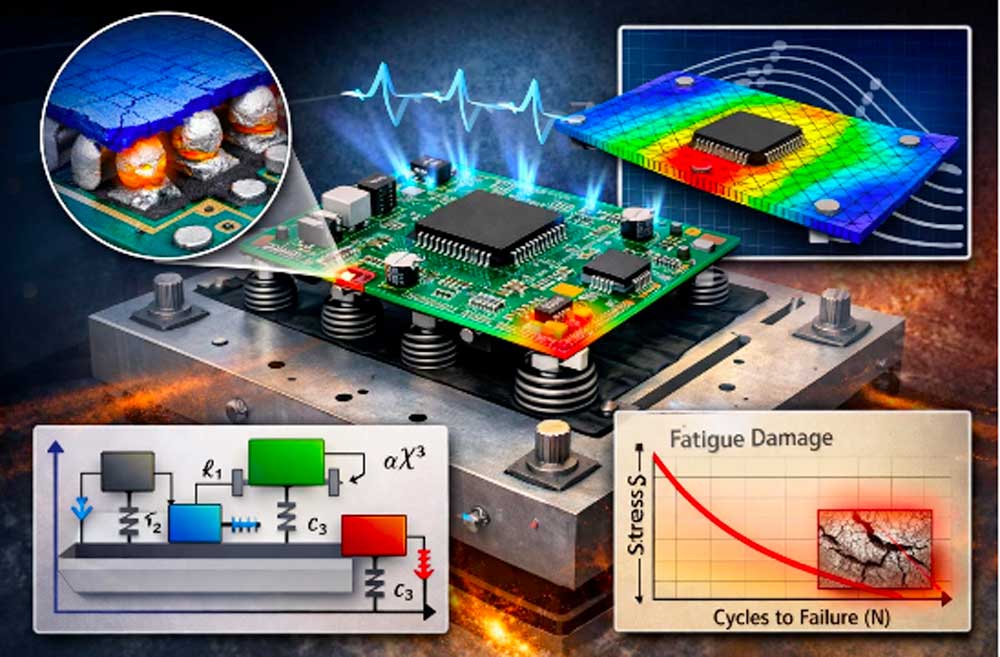
Photo provided by Sima Besharat Ferdowsi
 By Sima Besharat Ferdowsi Resiliency Fellow, Lamar University Center for Resiliency
This commentary was originally published by The CfR Research and Commentary on April 26, 2026
n today’s world, electronic components are everywhere, from smartphones and laptops to automotive, aerospace, and industrial systems, including applications such as vehicle control units, oil and gas monitoring systems, and manufacturing electronics. Many of these devices operate in environments where mechanical vibrations are unavoidable. Modern electronic systems are therefore expected to operate reliably in environments that are mechanically hostile. From ground vehicles and aircraft to energy infrastructure and defense platforms, electronic assemblies are continuously exposed to harsh vibrations originating from moving bases. At the same time, advances in microelectronics and the demand for higher performance, portability, and energy efficiency result in the development of devices that are smaller, lighter, and more densely integrated than ever before. As a result, ensuring their structural reliability under these dynamic conditions has become increasingly challenging.
In addition, electronic packages are transitioning from cloud computing environments, which are relatively controlled, to edge computing environments that are much less predictable. This shift presents new challenges, especially in high-vibration environments such as transportation systems.The durability of critical components, such as solder joints, is crucial for the endurance of these packages because they provide both mechanical support and electrical connectivity between components. These joints can experience fatigue under harsh conditions, which may lead to early failure of the entire electronic system.
Despite this reality, most of the reliability models still rely on simplified linear assumptions that weredeveloped for lower loading conditions. However, in real-world vibration environments, electronic assemblies are often subjected to high excitation levels that can push their structural response beyond the limits of linear behavior. Printed circuit boards behave as flexible structures with distributed mass, in which geometric nonlinearities, such as large-deflection bending and mid-plane stretching, become significant under dynamic loading. In this circumstance, solder joints, often the most vulnerable components, exhibit material nonlinearities, cyclic degradation, and microstructural evolution. Under high excitation input, geometric and material nonlinearities interact in ways that cannot be fully captured by linear modal superposition or constant-stiffness representations.
To address these limitations, the research aims to develop a simple and practical method that can be applied to electronic assemblies operating in vibration environments. To do this, the research focuses on three main areas: vibration testing, material behavior, and nonlinear modeling of electronic assemblies. Before explaining each one, it should be mentioned that the focus is on board-level ball- grid-array (BGA) packages, where small solder balls connect the electronic package to the printed circuit board. These solder balls not only carry electrical signals but also support the components mechanically, making them the most vulnerable parts under vibration.
In vibration testing, most conventional fatigue tests are performed at a fixed excitation frequency. However, as damage accumulates, the natural frequency shifts, and the test no longer stays at resonance. To overcome this, we developed an accelerated fatigue test using a phase-locked-loop (PLL) control system. This method keeps the system at resonance by tracking the phase, allowing the test to continue at high amplitudes and producing more reliable fatigue data.
From a material perspective, this work compares the vibration reliability of two common solder alloys, SAC305 and Innolot, under both harmonic and random loading. By combining experimental testing with finite element analysis, the study evaluates their stress–life behavior. The results show that although Innolot experiences higher stress, it provides longer fatigue life, making it more suitable for harsh vibration environments.
The main focus of this work, however, is on nonlinear modeling of electronic assemblies undervibration. In real operating conditions, the system response changes with vibration level, especially near resonance, where geometric and material nonlinearities become significant. Traditional linear models cannot capture these effects. To address this issue, this research develops a nonlinear system identification approach based on response data that is obtained from experimental vibration tests under base excitation. Instead of relying on input force measurements, which are not available in practice, the method reconstructs the restoring force from the measured response and expresses it in the modal coordinates. Then, the nonlinear stiffness terms are identified using a least-squares regressionapproach. It allows the model to capture linear, quadratic, and cubic effects (nonlinear coefficients) directly from the experimental data. This helps the model to capture amplitude-dependent behavior and better represent how the system actually responds under different vibration levels.
The outcome is a practical model that better reflects the real-world behavior of electronic assemblies. It can help engineers predict how vibrations will impact the durability of boards and components, such as solder joints, over time. By accounting for these real, amplitude-dependent behaviors, this approach improves fatigue-life predictions and provides a tool for designing more reliable electronics for harsh vibration environments.
Why This Work Is Important
Electronic assemblies during operation are subjected to environmental stress conditions such as temperature cycling, dynamic loading, and humidity. Among these factors, thermal loading has historically received the most attention because it has long been recognized as a major cause of fatigue failure. However, vibration loading has received relatively less attention despite its growing importance. At the same time, the electronics industry is transitioning from cloud computing systems that operate in controlled environments to edge computing platforms that must operate in uncontrolled, often harsh conditions. This shift has significantly increased the importance of understanding how vibration affects the durability of electronic hardware.
Failures in electronic assemblies are frequently associated with solder joints in printed circuit board assemblies, which are often the most vulnerable components and a primary cause of system malfunction. Studies indicate that approximately 20% of electronic product fatigue failures are caused by mechanical shock and vibration. During shipping, handling, and service life, electronic packages are frequently exposed to dynamic excitations that may lead to fatigue cracking in solder joints. A major reason for such failure is the bending mismatch between the printed circuit board and the mounted components, which places repeated mechanical stress on the solder connections.
Therefore, understanding and predicting the fatigue life of electronic assemblies under vibration is necessary to ensure product reliability. This is especially important for modern electronic systems used in critical applications, such as aerospace and defense systems, where failures can result in significant economic losses or safety risks. On the other hand, in these applications, even a small component failure can compromise the performance of an entire system.
Despite the growing importance of vibration reliability, many analytical and predictive approaches still rely on simplified linear assumptions developed for lower loading conditions. Under high excitation levels, geometric and material nonlinearities can interact in complex ways. This phenomenon causes the vibration behavior to be unable to be fully captured by these simplified linear models. As a result, the response is often inaccurately predicted, leading to significant errors in reliability assessment, such as overestimating the fatigue life. Therefore, there is a strong need for modeling approaches that better represent the real mechanical behavior of electronic assemblies.
For this reason, developing a practical and physically meaningful methodology for evaluating vibration-induced fatigue is critical. A reliable modeling framework can help engineers design more durable electronic systems and improve testing strategies for predicting product lifespan. Finally, improving the reliability of electronic assemblies helps ensure that the technologies which we rely onevery day, from vehicles and communication systems to energy infrastructure, continue to operate safely and effectively in demanding environments.
Engineering and Industry Applications
From an engineering standpoint, this research proposes a method that can improve how the reliability of electronic assemblies is evaluated when they operate in vibration environments. Electronic components in real systems rarely experience simple or constant loading. Instead, they are exposed to different vibration levels that can gradually damage solder joints and other critical components. The modeling approach, which is developed in this work, attempts to capture that behavior more realistically. By better representing how electronic assemblies respond to vibration, engineers may be able to estimate fatigue life more accurately and make more informed design decisions. This could affect how printed circuit boards are designed, how solder materials are selected, and how electronic systems are placed within vibrating structures.
Implications for Policy Makers and Infrastructure Planning
The impact goes beyond engineering design. On the other hand, these days, many advanced systems depend on electronic components for monitoring and control. When these components fail, the effects can extend beyond a single device and disrupt larger operations. For that reason, a better ability to predict vibration-related failures can be useful for policymakers and decision makers, who are responsible for infrastructure, transportation systems, and industrial safety. More reliable predictions help engineers and decision makers choose better equipment standards, plan maintenance more effectively, and improve safety practices. These insights can also support equipment certification, maintenance guidelines, and safety regulations in industries where electronic systems are exposed to vibration.
Benefits for Southeast Texas
These considerations are especially relevant in Southeast Texas, where many refineries, petrochemical facilities, and manufacturing plants use heavy equipment that runs continuously and generates. significant vibration. So, electronic assemblies installed nearby must function under those conditions for long periods of time. Besides this, many facilities in this region experience environmental stresses like high humidity, heat, and severe weather events, such as hurricanes and flooding. In such environments, the durability and reliability of electronic assemblies become especially important. Reducing unexpected failures helps avoid costly production interruptions and improves workplace safety. In industries that are important to both the regional and national economy, even small improvements in reliability can have a real impact. While this discussion focuses on Southeast Texas,similar challenges exist in many industrial regions where electronic systems operate under harsh conditions.
In summary, the practical stakes are straightforward: fewer unplanned shutdowns, lower maintenance costs, safer working conditions. But the longer-term contribution may be in establishing a more rigorous baseline for how the industry thinks about electronic reliability in harsh environments. That has value beyond any single facility or storm season.
More About
Sima Besharat Ferdosi is doctoral Candidate in the Department of Mechanical Engineering. Her doctoral research focuses on semiconductor reliability modeling and testing for harsh environments, particularly in sectors such as the petrochemical, transportation, and aerospace industries. She investigates vibration-induced degradation in electronic systems and develops predictive modeling frameworks to enhance their safety, durability, and performance under extreme operating conditions.
As a CfR Graduate Fellow, I aim to connect my research with real resilience challenges in Southeast Texas. I am here to engage with researchers and industry partners, build cross-disciplinary partnerships, and explore opportunities to translate advanced reliability modeling into practical solutions that strengthen critical.  sbesharatfer@lamar.edu Expertise: Nonlinear System Identification; Printed Circuit Board (PCB); Base Excitation
Topics
Nonlinear Modeling
Printed Circuit Boards (PCB)
Solder Joint Fatigue
Ball Grid Array (BGA)
Edge Computing
Finite Element Analysis (FEA)
Accelerated Fatigue Testing
Solder Alloys (SAC305 / Innolot)